Home › Templates › Free Images for Websites License: Public Domain vs Licence
Free Images for Websites License: Public Domain vs Licence Edition
Using an image on a client site without repercussions depends on the licence terms and any residual rights, not just where the "free download" button is.
In this article
It's easy to see safety in the word "free", but it's not the same as "public domain". Even licences that make an image free to use will sometimes forbid redistribution or resale of the image in standalone form, especially if the site has added value by curating the collection. The safest bet is to understand exactly what "free" means from each source - and to scroll through the licence text to read even what's printed fine.
Licence families: what “free” actually means
All "free" image licences come in one of two families: Creative Commons or platform-specific. The key question is whether you'll still need to seek permission or give attribution, even if the word says the download is free.
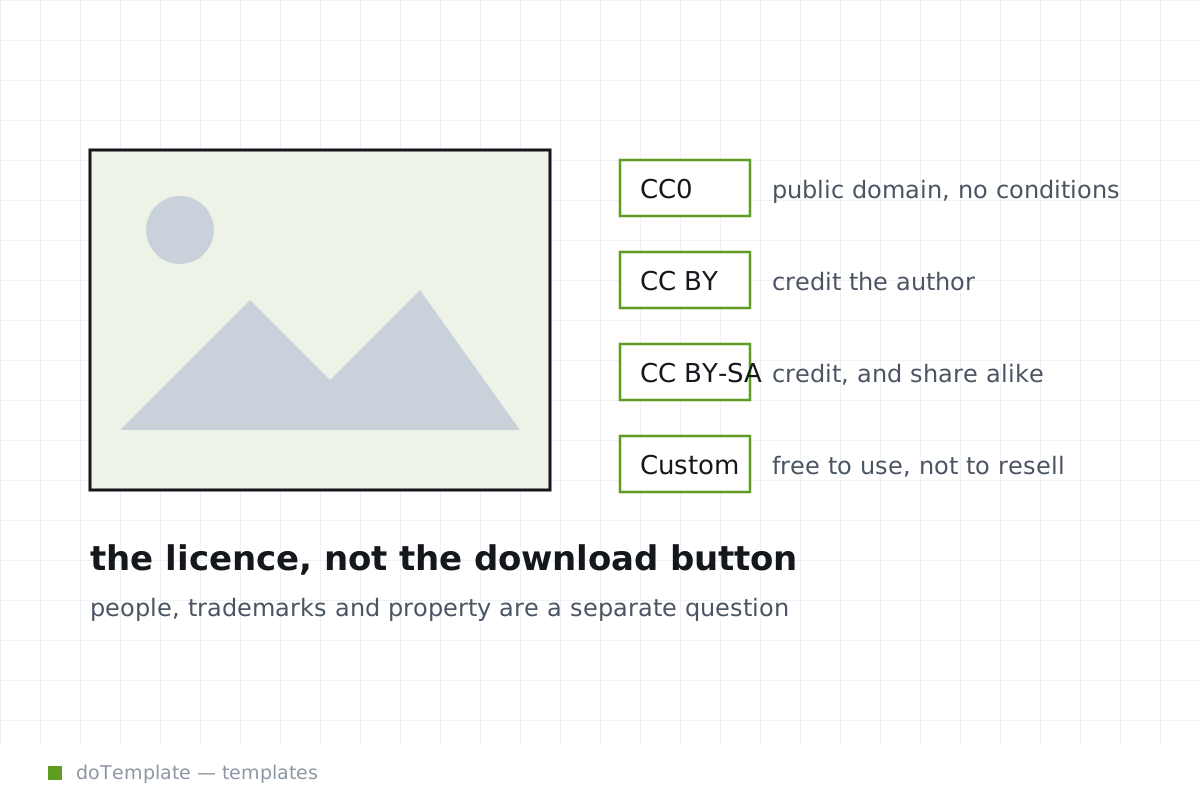
Creative Commons licences mix attribution requirements with usage allowances. A CC BY licence lets you freely reuse an image in any setting, so long as you give credit. CC BY-SA (By, Share-Alike) requires both credit and that adapted versions be released under the same terms.
Creative Commons lists six licences: CC BY, CC BY-SA, CC BY-NC, CC BY-NC-SA, CC BY-ND and CC BY-NC-ND Without speculation, I cannot say whether those six are the only licences that CC has ever produced, or might publish in the future.
But staying within that brand is no guarantee of free re-use without a formal credit. In commercial settings, that limits the uses. Creative Commons says CC BY-NC licences forbid commercial re-use, a term that depends on the setting of the use, not the identity of anyone who uses the image More restrictive still is CC BY-ND (No Derivatives), which allows images to be used, but not adapted or shared in remixed formats. Images under this licence can be lawfully shared, but modified versions cannot be circulated.
That makes looking at platform-generated licences a grudge option for many who want to repurpose an image. That's despite some undeniably broad terms. Platforms like Unsplash say free-reuse grants are irrevocable and worldwide. That applies to free commercial licensing, attribution is not required — even for re-worked versions of the image. Unsplash's licence text says it does not include the right to compile images to replicate a similar or competing service, such as compiling the collection as a stock photography offering. The print also says attribution is not required for standalone downloads or third-party integrations.
Creative Commons, clause by clause
Creative Commons has frontline advice for attributing an image it licenses, though researchers report problems in actual practice. The most important rule is that the credit must be "reasonable," not enough to suggest the licensor or its content is directly tied to the reuse. Credit is not required for attributions styles that are separate from the content, such as in the "About" section or metadata, but must be alongside the content itself if it's prominently displayed.
The open licence family makes a distinction between the NonCommercial and NoDerivatives labels in particular, but not by laying treaty or statutory obligations.
CC0 and public-domain style reuse
Broad attribution rules apply to creative-commons branded images in most instances. But acknowledging creators and owners isn't always a need that branding can't shield. Creative Commons uses a mark called CC0 to signify works so fundamentally available that they're like public domain. It defines CC0 as a "dedication to the worldwide public domain to the fullest extent allowed by applicable law". Rarely does it cover exclusively government-waived text use. The dedication excludes no rights owned by copyright holders, nor are they barred by third-party regimes The entry presentation is translated into many official languages as a summary for provider cross-page distribution.
The CC0 dedication does explain some but not all public-authority provisions, so it can't truly be described as a public domain designation replacement on commercial operating platforms.
Stock-site licences are not public domain
Reuse without any of the conditions listed above is still a pipe dream for most. That includes even a high profile platform like Unsplash, which licences images for free use, but still enforce a package of limiters. The Unsplash licence quite specifically says users agree not to sell or compile the repository set for their own aggregation. Since it's not a library wholesaler, that doesn't hobble individual image reuse or even redistribution after attributions or credits are made. But it does distinguish Unsplash's licence wording from truly released public domain resources, where usage restrictions are completely waived — and no attribution is required, even if it would provide scalable proof against future licence disputes.
Attribution isn't entirely bypassed either. While website downloads don't require mentioning the source, Unsplash says its API integrations require giving credit.
Attribution and compliance
There's no font, formatting, or tagger that makes an image attribution linkage truly compliant without reviewing the source licence. The main playbook is to credit properly, in text where the image appears. Creative Commons recommends making a credit like this:
The official document from which this attribution guide is necessarily displayed gives an example what an attribution looks like in practice. [11][13]
The attribution is not enough to support a publisher if a licence operation enforcement department subsequently detects unauthorised usage. But Creative Commons creates a template that could help publish a compliant — and useful — follow-up if challenged for misuse.

[11][13]
There are risks in license-linked steps going forward. Plenty of publishers risk letterheaded requests for proof about image rights, or inadvertent clicks followed by claims of usage enforcement. The question is whether Committing to common compliance, still without a foolproof system, inspires safety or a placebo.
But if non-serious work is shared, an increased chance of realism. To restrain yourself from citing to everyone!
A CC0 deed releases to public domain. Therefore, reusers may do anything they like: CDN, upload, sale, etc
## What remains unresolved by the licence alone

Using images freely is rewarding, but chosen with care. A platform licence is helpful but — as it meets Unplash's free licences — will sometimes limit use. CC licences are also diverse ways to provide freedoms, but sustaining them properly (and crediting as required) is critical. Getting this right is as crucial as not writing an express licence. Attribution is rarely enough, but always required for auditors to cross-check, whether in third-party directions or their own descriptions by the plain meaning of a Creative Commons licence. But there are few cutting-edge tools to certify this for a document or public record.

Looking for an attribution template? Find one online, but be advised: The CC licence you seek may have slightly different language than another, and may describe your sources in different ways.

Looking to document your attribution for local records, or a court report? That, too, is a referral you may need to get from an artist or unaffiliated advisor. Compliance was important; confidentiality, even more.